Role of SolidFire networks in SolidFire storage replication
Everyone should get the hard-to-find TR-4741 (NetApp Element Software Remote Replication), but to answer the simple question: "all of the above".
- Management network is used for management traffic
- Storage (iSCSI) network is used for storage traffic (including storage replication traffic)
Similarly to what I did in this post, I configured solidfire-exporter to watch a replication Target cluster's network traffic on Management and iSCSI interfaces.
This cluster, called thin, was a replication Target for another SolidFire singleton cluster, called thick.
I paired the clusters, created two equally sized volumes (2GB, one on each cluster), set the one on thin to be Replication Target, paired the volumes for asynchronous replication, and used a Linux client to perform I/O to the volume on the Source cluster (thick).
I wanted to see which type of traffic - Management or Storage - will increase on the cluster hosting the Replication Target volume when bursts of I/O activity happen on the cluster hosting the Replication Source volume. (The image may be open in new tab.)
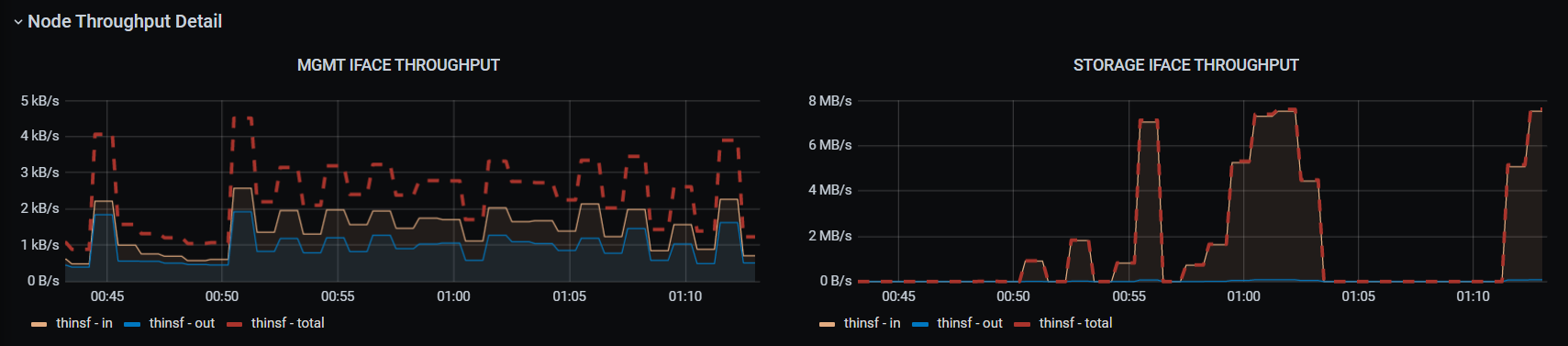
As you can see, traffic peaks on the storage network were significant. Three fio runs resulted in three pronounced peaks seen in the chart on the right.
However, the management network is still used, and must be redundant (and its traffic cannot fail-over to storage network).