Improved Kompromise webhook for NetApp StorageGRID
Introduction
Kompromise is v2 of my PoC project for S3-based data pipelines with NetApp StorageGRID and Versity S3 Gateway, based on last year's "GO NATS!".
It aims to create a no-nonsense, fully functional, production-worthy pipeline demonstration. The first Kompromise post last June (link above) was the initial "alpha-grade" stack. Since then I've been busy with other (and simpler) projects, but a lot of those have been successfully completed, so this weekend I spent some time revisiting Kompromise and made some progress.
As a reminder for those lazy to click:
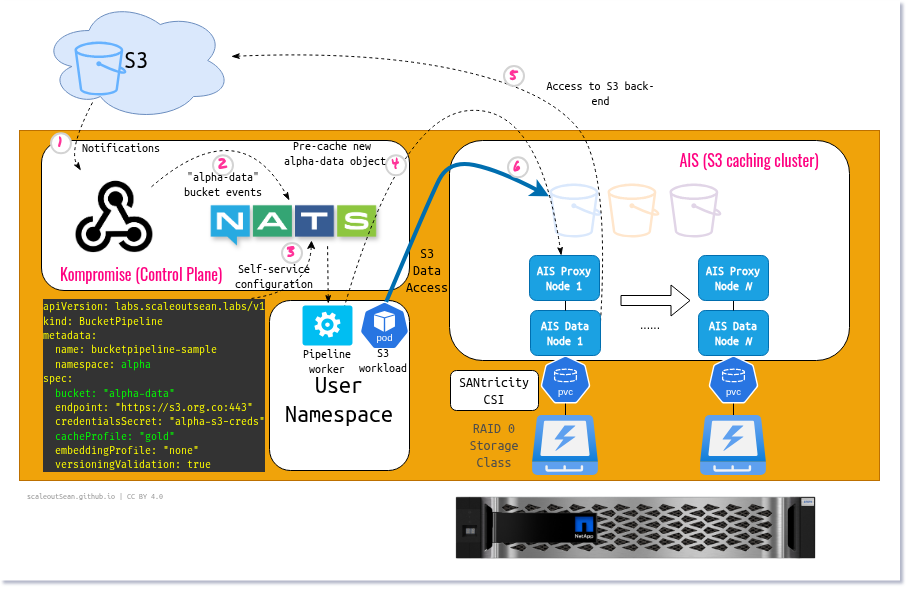
Given the code's immaturity, there are many areas that need to be fixed. I started from Step 1, webhook service.
Kompromise webhook for StorageGRID
That's the first two steps from the diagram above:
- Receive notifications from StorageGRID Webhoook notification service
- Send to processed object (meta)data to designated NATS subject
What's been improved is support for StorageGRID only, because notifications on the Versity S3 Gateway are currently very basic and will change (if they improve them). Improvements for Kompromise Webhook with StorageGRID:
- Reliability - handles objects that get deleted before enrichment and more
- Enrichment now offers basic and advanced notifications. Advanced pre-fetches object details, freeing the user from having to do that on their own in Step 3
- Added S3 authentication needed for rich notifications, uses STS Assume Role
- Fixed convention for subject naming in NATS (step 2)
Walk-through for Kompromise webhook
StorageGRID platform services must be enabled, and notification endpoint has to be set up.
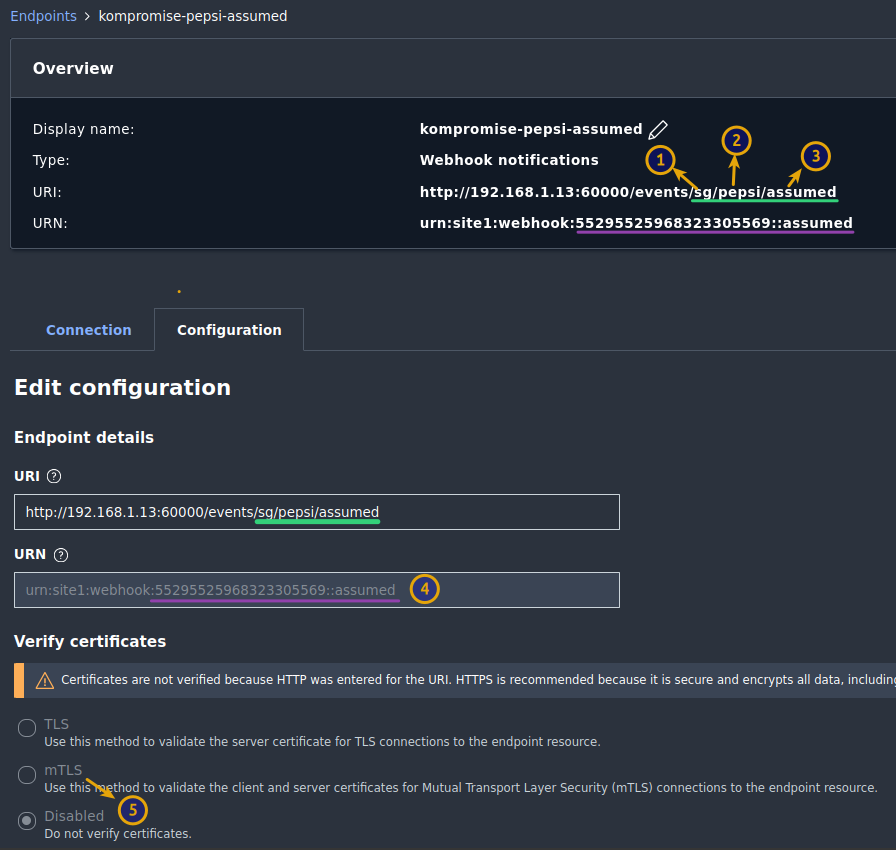
- (1)
sgfor StorageGRID - (2)
pepsiis the tenant name - (3)
assumedis the bucket name - (4)
assumedis not assumed from (3) but the topic name from actual XML notification configuration in the bucket. If this bucket had more notification created, this string would have to be different for each - (5)
mTLSis strongly suggested for production environments, but requires configuration on both Kubernetes (where Kompromise Webhook is expected to be, although it can run stand-alone) and StorageGRID side. With mTLS, StorageGRID nodes use Kompromise-issued TLS key to identify themselves when sending notifications (v12.1). Notifications from thepepsitenant then contain client TLS certificate details:
"tls_client_fingerprint":"5bc3ecbac9d8874894baac2dd2e74ed15a293d42c8a69a71ae781fdf136bfb73","tls_client_serial":"206237059971702461380099440429561764097341810725",
"tls_client_issuer":"CN=Kompromise CA,O=Kompromise",
"tls_client_subject":"CN=pepsi,OU=assumed,O=Kompromise",
"tls_cipher":"TLS_AES_128_GCM_SHA256",
"tls_version":"tls1.3"
Bucket owner configures Webhook service for s3.events.<namespace>.<bucket>.<pipeline> in Kompromise and - depending on whether notifications are basic or advanced, Webhook sends event data to the right NATS "topic" (subject). Using the example above, NATS subjects would be named:
- Simple:
s3.events.pepsi.assumed.raw - Enriched:
s3.events.pepsi.assumed.enriched(contains object metadata and tags)
Simple provides less data, but has reliable delivery, while Enriched does more but can fail mid-way (crash, network disconnect, etc.) and there's no "retry" (since StorageGRID has already delivered the notification, and Kompromise Webhook does not retry). If you need "reliable Enriched", you can use Simple and create your own enrichment pipeline that uses same NATS service for reliable enrichment.
The first Kompromise post at the top has demonstrations of example functions that can be created and deployed by the pipeline owner. The ETL function for video content shown there is one such example which only needs a simple notification and the rest is handled in user's ETL function, so that is already available.
Next steps
NATS
The Webhook now sends data differently, so NATS configuration and pipeline setup must be updated and improved.
It needs a better configuration, mostly, to implement stronger user segregation, considering that NATS is a shared service managed by the Kompromise admin. If you don't want to have one Kompromise service (and one NATS cluster) per each bucket, you need secure multi-tenancy on shared services (NATS and AIS, primarily).
While this worked in Alpha, it had some loopholes, and needs improvements.
AIS
AIS (S3 cache) integration also has to be reworked, unfortunately.
I underestimated the complexity of multi-tenancy. Not of implementation itself - it can be done - but of using such stack: with a stack like that one can't just kompromise up - far from that.
The user would have to RTFM, understand implications of networking choices, and couldn't even do that without extensive knowledge of StorageGRID (and S3 in general). Which, realistically, nobody wants to do.
How I'm changing it is: remove multi-tenancy which is the source of implementation complexity, and yet unimportant because I'm building this for E-Series. Unlike AIS, which recommends multiple NVMe physical disks per node, E-Series doesn't need to care about that.
I can create small AIS clusters and use SANtricity CSI or TopoLVM to create PVCs of arbitrary sizes on either protected RAID 10 or unprotected RAID 0 disk groups (with AIS RF=2 or RF3 in the latter case).

Each user still gets enough S3 cache to speed up data processing. The only downside is potential over-provisioning, so some care and PVC fullness monitoring needs to be exercised because SANtricity doesn't have Thin Provisioning (SANtricity CSI fully provisions PVCs; TopoLVM it may be different because it provisions LVMs, not LUNs, but I haven't checked).
Other thoughts
Someone may ask why is it so complicated? Why bother? And let's throw in a "whataboutism": what about Open Source S3 Notification Webhooks?
It's not exact complicated, it just needs work and I have 20 things going on.
One of the other reasons it took me months to start working on this again was I probably spent days (on-and-off) exploring various angles to improve the design, but none of them worked out: not possible, too hard, too complicated to use, etc.
Why bother? Why do we need this anyway?
NetApp StorageGRID still has the same, basic search integration from last decade.
In 2024, Kafka notifications were added and Webhook notifications after that. These are fine - they do one basic thing (notify) and the AWS specs don't leave room for arbitrary innovation, so it's different from Search which is up to each Object Store's integration (StorageGRID doesn't serve AWS S3 Vectors API, for example). The basic Search functionality and S3 Vectors was what motivated me to do "GO NATS!" last year.
Anyway, so I consume Webhook notifications in Kompromise - but don't do anything for search. Notifications are just the shovel for the "shovel-ready job" that modern search is. You have to take care of the job yourself until they build something that may or may not work the way you want.
That's why Kompromise is valuable to me: I'm trying to create a pipeline tool that works for unstructured data (images, videos, unstructured text) exactly the way I want it. To do that, I don't use Search integration because it can't do what AI workloads require. We need to use the shovel (notifications).
Now, I can't change how StorageGRID Notifications work. I could send Notifications to a Kafka (more reliable) or Webhook service (little less reliable). Kafka is a hog and if you want to send to Kafka, go ahead.
You can skip Kompromise Webhook and send Kafka Notifications directly to Instaclustr-managed Kafka, as a way to get the benefits while outsourcing maintenance to the professionals. For me, NATS does the job close enough and it's easier to use and manage. So I use Webhook and NATS.
The Webhook looks good enough now, so I'll probably release a stand-alone binary and container image that can be easily used with any NATS instance for whatever purpose - those who have no need for AIS and S3 caching can probably use it for something else.
For the purpose of processing large data objects, Kompromise benefits from AIS, and NATS needs reliable block storage as well. If you make good use of three-to-six LUNs for AIS and three for NATS and save by not spending $500K on something else, it makes sense to buy three EF50 arrays and take care of all block storage needs. Now, that is interesting. You have a better service and you didn't waste $500K on nonsense. Good job!
Stand-alone Webhook service that sends data some NATS to do something I don't know about is viable, but less interesting to me from a solutions architect perspective - it's a little bit like an open-ended "what's better" question that has no conclusive answer. Not interesting.
What about Open Source Webhooks? Recently I've stopped wasting my time on open sourcing these projects, and this week I realized that's a new and pertinent question. Why use Kompromise Webhook when I can use my own or some open source S3 notification Webhook or send directly to Kafka instead?
One of the purposes of these projects is to encourage NetApp users to build integrations rather than wait for "features", so if anyone builds their own, that's the ideal outcome.
Whether some generic S3 notification Webhook works, what's better, what's not, etc. I don't know and - to be honest - I don't care unless I'm engaged in a situation where I need to answer that for work. I know mine works exactly the way I think it should with StorageGRID ("rich" notifications don't even work for the Versity S3 Gateway at this time, although I'd like them to work with both) and I can change it when I see it doesn't.
Kompromise Webhook has a "rich" mode which generic Webhooks usually don't have. So, another way to ask the same question could be "why does Kompromise use its own Webhook?" and the answer would be "because it works better, as far as I can tell".
Conclusion
The Webhook component of Kompromise is beta-grade now and might be decent enough for simple non-critical use cases.
Some might ask what "non-critical" use cases can be when notifications can fail? I answered that in the first Kompromise post: if the pipeline is object pre-caching (which is why Kompromise has AIS - that's the main pipeline), worst that can happen is a slower, non-cached read.
There are many "professional" solutions out there, available from vendors ranging from datalake platforms to start-ups, so for truly "mission-critical" everyone will buy or rent one of those, to have someone to blame or sue. Nobody would use Kompromise for that in any case.
Kompromise just needs to works good enough to prove the concept and idea is sound, so that you can build one like it if you want. The basic pipeline is simple, there's no bloat, failures are low-impact events, and the rest is based on proven open source components. It's free, but worth more than it costs. If tenants must be absolutely segregated, run per-tenant Kubernetes on Kubernetes.
I'm approximately 20% done with this pass. To-do items that remain:
- NATS configuration improvements
- User pipeline configuration updates to reflect changes in Webhook and NATS
- Add an additional ETL demo function(s) that I had in "Go NATS!", that can create embeddings from content. And a search API as the main use case for "rich" Webhook notifications I added today
- Documentation
- Testing
- Packaging (binaries)