Lakekeeper Iceberg REST Catalog with NetApp E-Series
- Lakekeeper Iceberg REST Catalog with NetApp E-Series (this post)
- Lakekeeper with NetApp StorageGRID
Introduction
What's Lakekeeper?
A secure, fast, and user-friendly Apache Iceberg REST Catalog built with Rust and available under the Apache License.
How is that related to NetApp E-Series? Lakekeeper needs to persist data somewhere.
This post will take a look at those needs, and a future posts may explore certain aspects in additional detail, especially since we've been playing with OpenSharing and it's clearly a great use case for E-Series that justifies additional exploration.
Lakekeeper interfaces
To see what storage Lakekeeper consumes, we look at this image (credit: lakekeeper.io):

There's just this:
- Persistence backend: Postgres
- Secrets store: Postgres or Hashicorp Vault
- Object store: self-managed S3
- Events store: NATS or Kafka
Postgres on E-Series rocks. We've seen it in performance, both here and here, we've seen it in HA clustering, manageability, DR and backup/restore.
NATS and Kafka: both work great on E-Series. Highly-available RAID 10 volumes on external storage give you get reliable, high-throughput, low-latency storage. Use one EF-Series box for a single rack deployment and three for a rack -redundant deployment where you can use entry level E-Series systems if you need rack redundancy more than performance.
Self-managed S3: pick one of three T-Shirt sizes for object stores
- Small: Versity S3 Gateway in VMs or Kubernetes
- Medium: StorageGRID SDS with E-Series - you need at least 3 1U servers and one E-Series box. Get three E-Series boxes for rack redundancy
- Large: NetApp StorageGRID appliances (the SG6x00 models, for example) - get three StorageGRID boxes and two S3 API gateways (one can be SG SDS (VM-based)) for rack redundancy
Lakekeeper is yet another case of a modern analytics stack that matches what was explored in this post:

That's exactly how it'd look like. The same pattern everywhere.
Consuming storage from Lakekeeper
Postgres is simply set during Lakekeeper bootstrapping - we just tell Lakekeeper what databases to use. In other words, Lakekeeper doesn't run Postgres DB service for you - you need to set these up and CNPG or some other established native clustering approach will do.
Or, if you need a source, RTFM:
Use an external high-available database as a catalog backend. We recommend using a managed service in your preferred Cloud or host a high available cluster on Kubernetes yourself using your preferred operator. We are using the amazing CloudNativePG internally.
I didn't know that before, but I'm not surprised. I should emphasize that CNPG backup is continuous and to S3 (the link provided just above) which is what lets you restore Catalog, secrets and rewind tables (versioned S3 objects) to the same point-in-time.
Then, in Lakekeeper Web UI, we start consuming (self-managed) S3-compatible object storage:
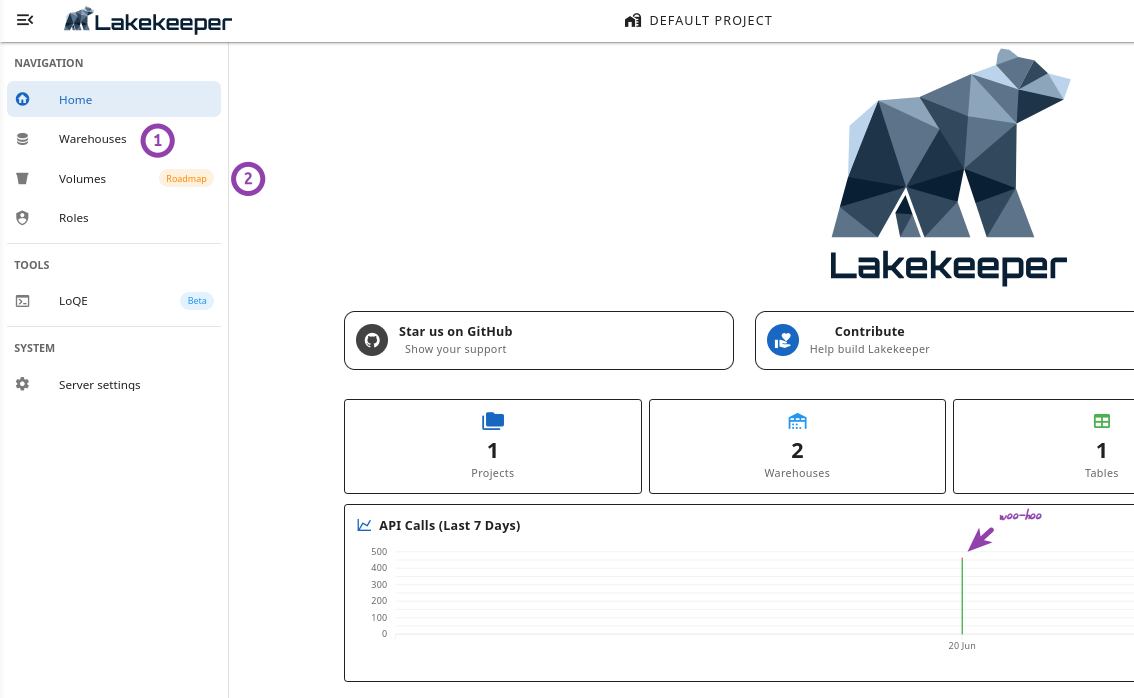
- (1) Warehouses ("just a bunch-o-tables")
- (2) Volumes - currently just a roadmap item, but I think this is absolutely fantastic as I've referred to this asset (Volumes) as the more positively disruptive one for E-Series. File sharing for E-Series, folks!
This week I blogged about OpenSharing Tables and OpenSharing Volumes, which is exactly what (1) and (2) do (only Iceberg instead of Delta Lake format).
Zooming in on Volumes, we can see "it's coming".
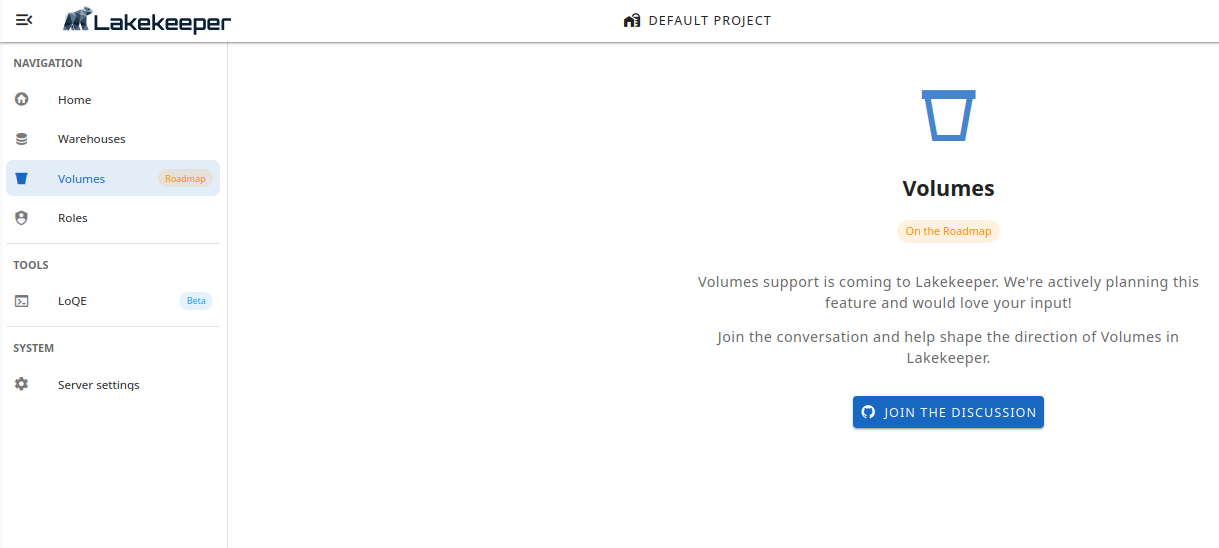
But, does Lakekeeper work with VGW and StorageGRID? I tried it, and it appears that way.
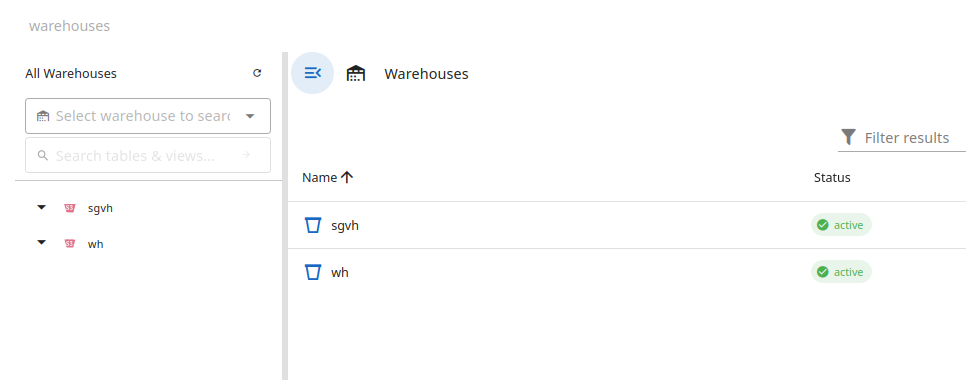
Not only does it work, but we know all three T-Shirt sizes work:
whis a Versity S3 Gateway-backed warehouse, which works the same way as our OpenSharing Tables approach: you can keep table data on E-Series and you can run Versity S3 Gateway containerized, even on Kubernetes which is ideal for low-cost deployments on Edgesgvhis a StorageGrid-backed warehouse, and since it's the same software stack on both the appliances and SG SDS, Medium & Large sizes work, too
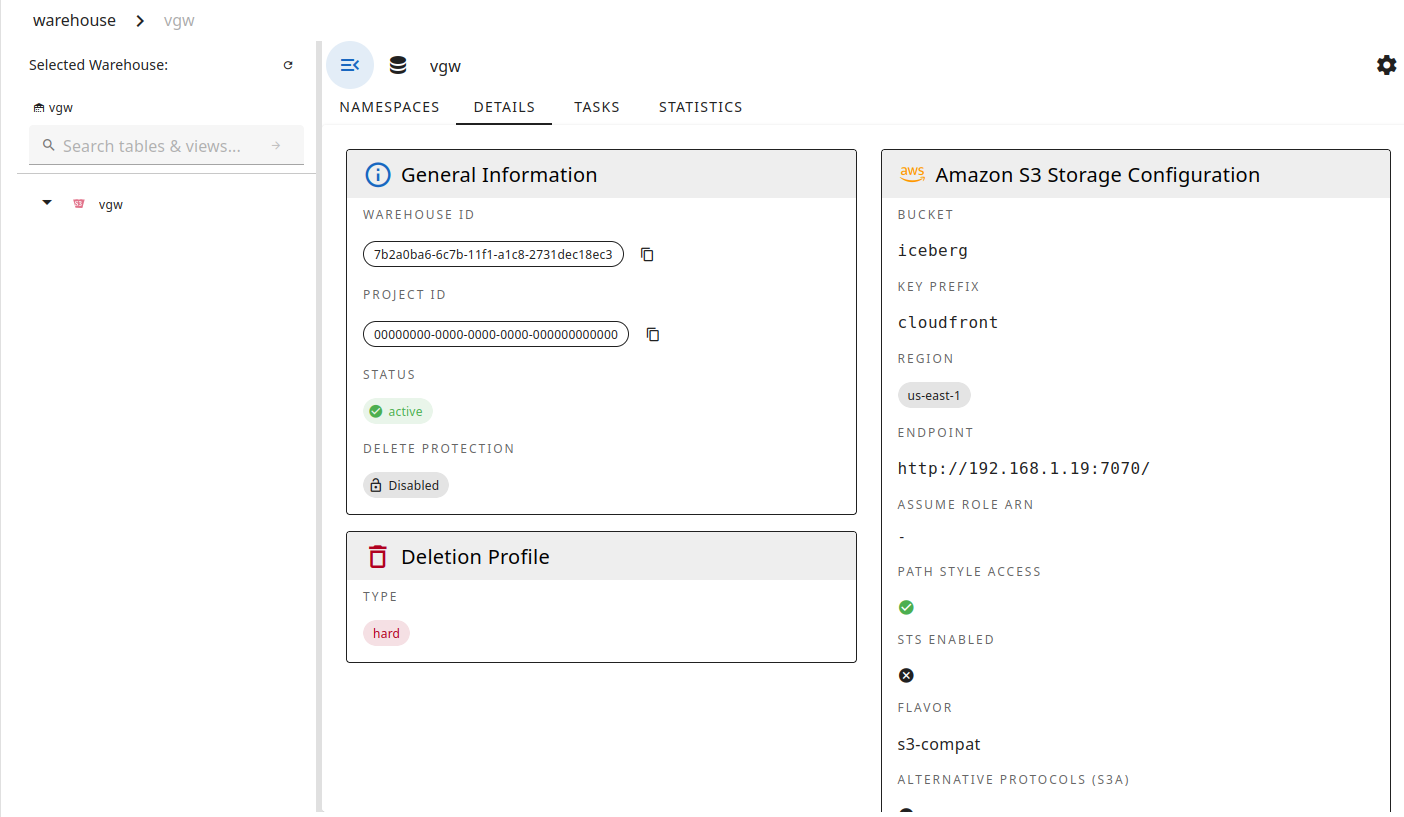
This is one of the screenshots of a Versity S3 Gateway-backed data warehouse, taken before the screenshot above while I was exploring the various S3 configuration options.
StorageGRID doesn't require special steps - just S3 Object Lock in GOVERNANCE mode.
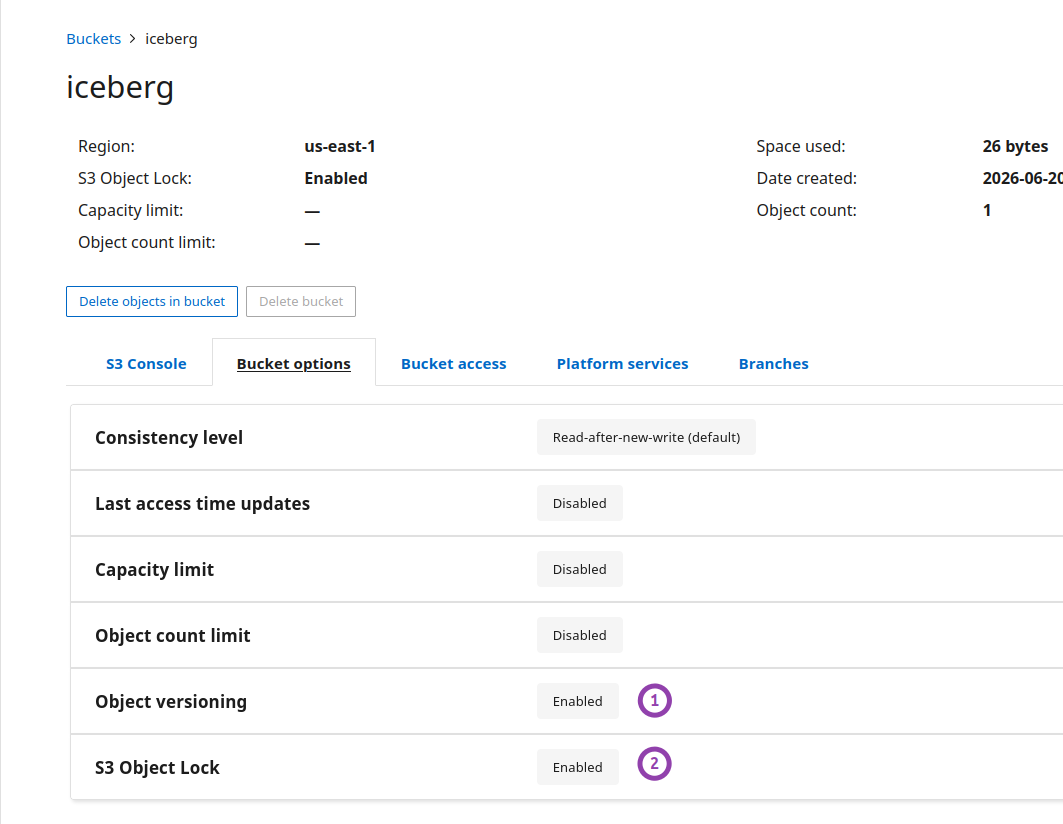
The VGW bucket had the same configuration:
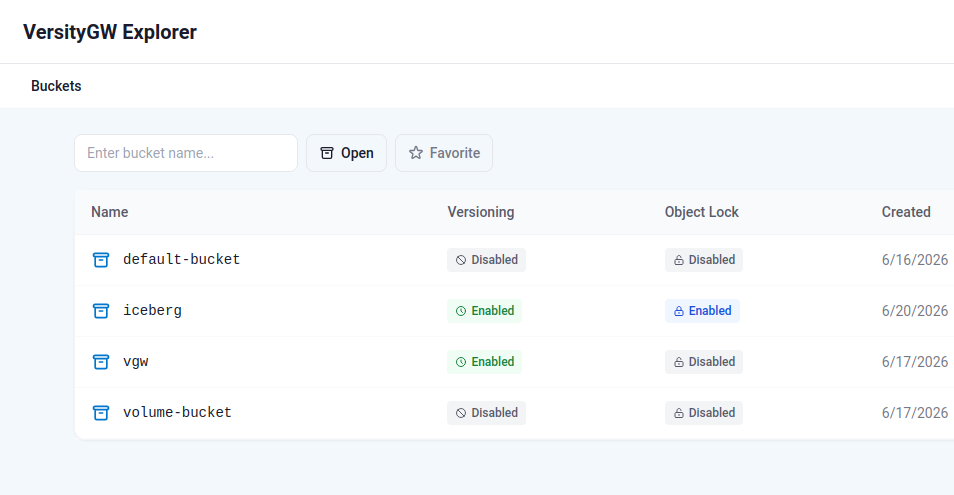
Initial access logs.
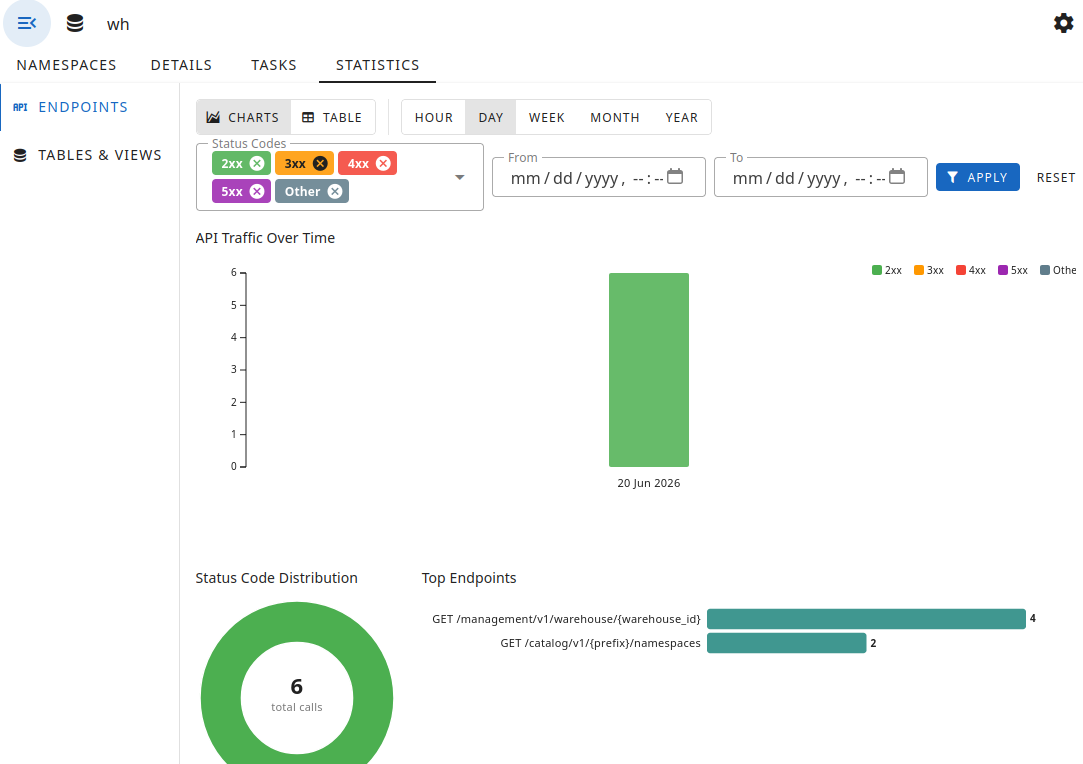
I created a namespace and several tables and it went without errors.
This concludes this "overview of architecture, requirements and getting started with Lakekeeper on NetApp E-Series" post.
Conclusion
Lakekeeper looks nice and I'm going to keep an eye on the progress of their Volumes feature.
Both Versity S3 Gateway with E-Series and StorageGRID are ready.
For smaller, edge, low-cost sites with less than 1 PiB, you can put the whole thing on a single (hybrid or all-flash) E-Series box, and for larger, Data Center, scale-out, enterprise environments, StorageGRID is more suitable.
- get at least one EF-Series box for Postgres and NATS/Kafka. Use TLC SSD disks for these services.
- use the same E-Series box for Versity S3 gateway (use NL-SAS for low-performance or cost-down) or StorageGRID SDS. Get more of them as StorageGRID appliances if you need to scale-out.
In a future post we'll look at specific Lakekeeper solutions and use cases.